
Check out The 16% Rule presentation slides here
Last year as part of my Masters degree, I wrote a paper on why iPhone adoption will be faster in Australia than the US
Key to this claim was Diffusion of Innovation theory, to which I introduced a new concept titled The Newton Ball Diffusion Acceleration Effect
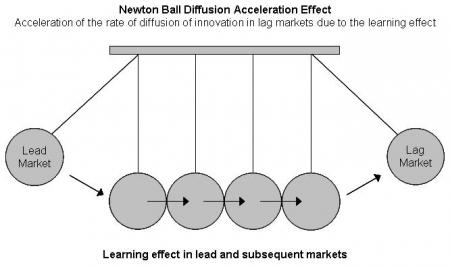
Newton Ball Diffusion Acceleration Effect
In the year since developing this concept, I have been testing another theory on several new product launches to accelerate diffusion of innovation.
Accelerating Diffusion of Innovation: Maloney’s 16% Rule
Firstly, thanks to the Diffusion of Innovation Adoption Curve developed by Everett Rogers we know the percentages of any population that make up each adopter category.

Diffusion of Innovation Adoption Curve
The theory is that each category of adopters acts as an influencer and reference group for the next.
But there is a problem with this theory, and it lies between the Early Adopters and the Early Majority.
These groups don’t reference each other because their Psychographics are very different.
According to Rogers, Early Adopters are “Visionaries” and the Early Majority are “Pragmatists”
It is like putting a marketer and a lawyer in the same room. They are unlikely to get along, or listen to each other.
In Groundswell, Forrester Research identify 6 Social Technographics and again there is an interesting intersection at around the 15% mark, where “Creators” are faced with “Critics”.
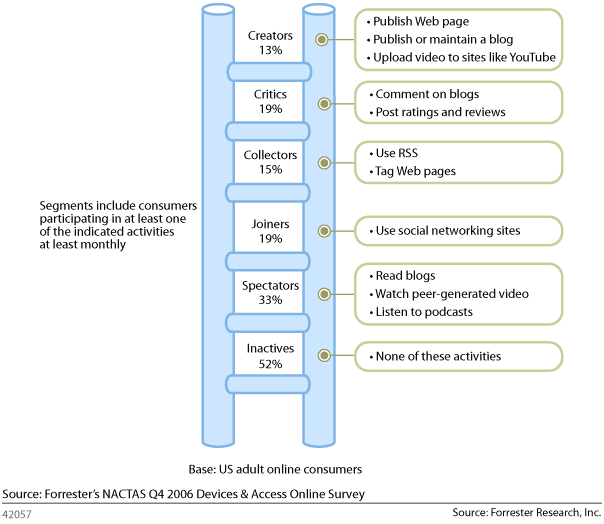
Forrester’s Social Technographic Ladder
Obviously these Technographic groups don’t exactly get along, but they still need each other to exist and grow.
Geoffrey Moore defined this gap between Early Adopters and the Early Majority as “The Chasm”, in his insightful book called Crossing the Chasm
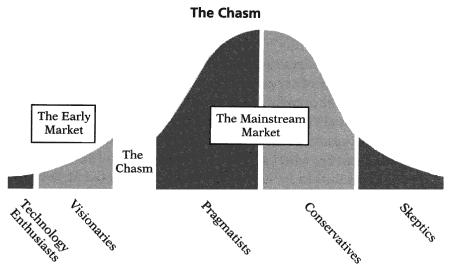
The Chasm as defined by Geoffrey Moore
Malcolm Gladwell defined the other side of this chasm as “The Tipping Point” or the point where the mainstream market starts to adopt the idea and the sales go through the roof.
So how do you cross the chasm to get to the tipping point?
How we answer this question requires a dig into persuasion theory.
In the book Influence: The Psychology of Persuasion, Robert Cialdini introduces 6 principles of persuasion; reciprocity, scarcity, liking, authority, social proof, and commitment/consistency.
There are two in particular that are extremely relevant for our problem; scarcity and social proof.
Innovators and Early Adopters are turned on more by scarcity. Basically they want what others can’t have or don’t know about.
The Early Majority (and Late Majority/Laggards) are more turned on by social proof. They want what many others have and are talking about.
But Early Adopters have a vested interest in the Early Majority not adopting the innovation because it takes away from their scarcity needs.
So it is up to us marketers to bridge this gap.
The Secret: Maloney’s 16% Rule
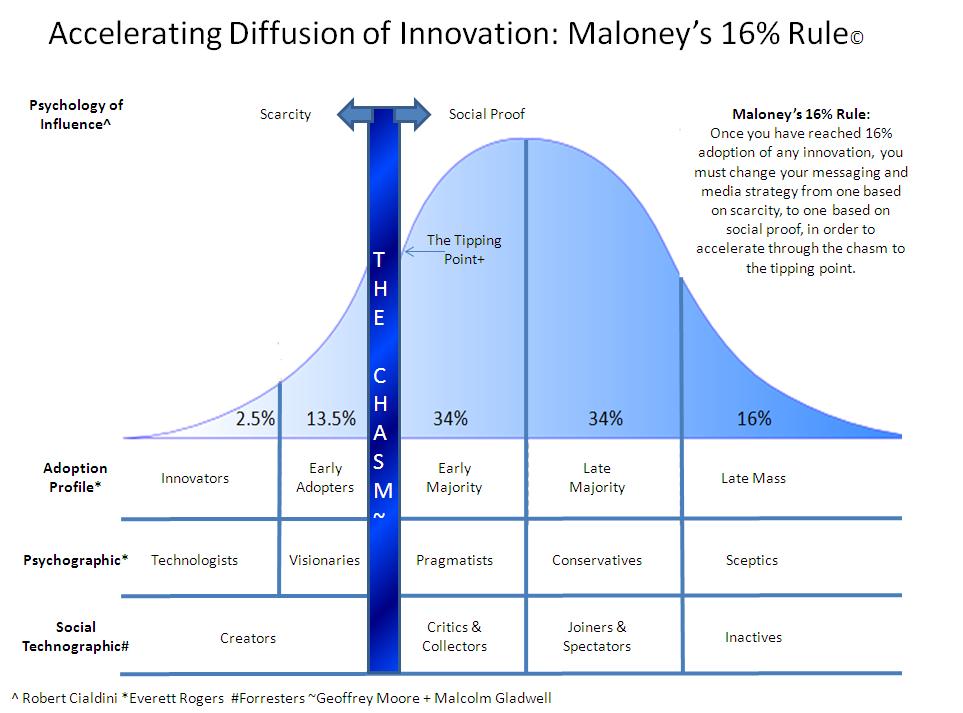
Accelerating Diffusion of Innovation – Maloney’s 16% Rule
There are two ways marketers can bridge the gap, firstly by altering their messaging/creative, then by altering their media mix.
Messaging
At launch of an innovation (be it a new product, service or idea), messaging should be playing to Innovators and Early Adopters’ desire for scarcity.
So messages such as “Be one of the first…” work well for these groups.
But at the point where 16% of the target population have taken up the innovation, the messaging needs to change to one that focuses on social proof.
For example “Join the 100,000 customers who have already bought this product”
Media Mix
Too many products are launched with a big bang TV commercial that is designed to get mass awareness (or to please the CEO).
In general, awareness can be achieved this way, but the concept is flawed from actually generating innovation adoption effectively.
Just like the messaging and innovation itself, information about the new product, service or idea should be scarce at first, in order to excite Innovators and Early Adopters.
These groups love it when they are the first to hear about something, so channels such as direct marketing, PR or targeted print advertising in trade media, Twitter, and Viral Marketing all work well.
Mass media is counter intuitive at this point.
Why would these groups want to talk about something you have already told everyone about?
It actually slows down Diffusion of Information rather than accelerating it.
But at the point of 16% adoption, in order to cross the chasm you need to switch to mass media in order to provide social proof to the Early Majority that this is a serious innovation, and not just something for Innovators and Early Adopters.
Or in other words use a one-two punch: lead with PR, follow through with advertising.
Check out The 16% Rule presentation slides
I recently presented The 16% Rule at ADMA Forum 2011 and The Customer Show, Sydney. You can check out the presentation slides here
More on Diffusion of Innovation
Why iPhone adoption will be faster in Australia than the US


 INNOVATE OR DIE
Just interested in where this ‘magic’ 16% figure came from?
Hi Phil, sorry if this wasn’t clear. 16% adoption is the point where Innovators (2.5%) and Early Adopters (13.5%) have all taken up the innovation and where the Early Mass is supposed to start.
Hey,
Just wanted to say that I’m a second year marketing student in New Zealand studying for exams and this was really helpful, as was CRS paper so thanks
Julie
P.S. I’m doing a double bachelor and my second degree is law
Thanks Julie, great to hear you found this useful! Marketing and law is definitely a useful combination. I have always been surprised how much time you spend with lawyers when you are trying to do cutting edge marketing!
Chris, very interesting article. I had read Gladwell’s “The Tipping Point” so I am somewhat familiar with the concepts, but I appreciated the fact that you walked the reader through the different theories and models that lead up to your own theory providing adequate context. The charts and diagrams are also very useful to bring the points home!
The conclusions you draw make sense and got me thinking of my own marketing strategy… We’re in the process of defining our marketing strategy for our first iPad/iPhone game!
Thanks Santiago – great to hear you found it useful. I am currently working up an expanded version of the theory with examples for Marketing Magazine later in the year – I will let you know when that comes out.
For your iPad/iPhone game keep in mind the diffusion curve is extremely short. You really need to be engaging your innovators and early adopters before it comes out. There are so many games out there that they can get lost in the back catalogue easily. For a great case study, check out the recent Bubble Ball media coverage http://www.reuters.com/article/2011/01/20/us-whizkid-iphone-idUSTRE70J05W20110120
Thanks for the comments.. Definitely – timing is key. Getting your name out and creating a buzz prior to your launch is very important given that your app only appears at the top of the recent releases list for a couple of days. That’s really the only “free” marketing boost you get (unless you’re incredibly lucky and get featured in one of Apple’s lists, which is a bit of a pandora’s box how that works). Our goal will be to get to as many early adopters / innovators prior to launch and during the first few days in the store to generate as much sales momentum as possible early on.
Best of luck Santiago!
Great article Chris- I am seeking to get my arms around the concept introduced
in terms of the early adapters having a vested interest in the early majority not adopting the innovation and the lack of communication between the two groups. The impression I have had about the early adapters from other things I have read is that they are motivated to 1) be the first to adapt and 2) tell other people they were the first to adapt. Based on #2, can’t early adapters be made to be an ally in diffusing an innovation to the early majority?
Hi Kevin, thanks for your comment. You are right that early adopters are likely to tell other people that they were first to adapt, however the people they are telling are most likely to be other early adopters (i.e. people like them).
There are a few that will help bridge the gap to the majority, but this is not true for all early adopters. To use them as an ally you would need to identify who these influences are (using tools such as Klout) and adopt an “influence the influencer” marketing strategy.
A good example of this in play is Pete Cashmore. Pete is an innovator/early adopter and communicates with other early adopters through his website Mashable. The early majority don’t read Mashable, but the gap is bridged when Mashable is syndicated onto more mass market titles such as the Sydney Morning Herald http://www.smh.com.au/technology/sci-tech/hiccup-cure-devised-by-13yearold-girl-20120507-1y7mz.html
Hope that helps Kevin
How do you know when you have reached the 16 percent tipping point if you don’t know the size of the market (for example, because it is a new market or a new marketing cateogry)?
Hi Bob,
It is always difficult in assessing the size of the market in a new category, you just need to make the most educated assumption that you can.
Chris
Hi Chris
I love the idea of the Newton Ball Diffusion Acceleration Effect, somewhat like a pendulum effect whereby the ‘energy’ or influence of innovators are transferred to the next, the early adopters across the tipping point to the early majority etc.
I’d like to propose another question, how long does the influence/ energy stay within a profile?
I’m studying marketing at the moment, going to use the Newton pendulum idea in my presentation! Thanks for sharing. I’ll be sure to quote your name 🙂
What fashion companies have you worked with before?
Ling
Hi Ling,
Glad you like the Newton Ball model and happy for you to reference it.
I’d say the influence/energy within a profile is dependant on a number of factors, including observability, communication networks etc.
The fashion labels I have helped out include Young Lovers and Vihuela. Case studies here
https://innovateordie.com.au/2010/04/12/how-do-you-build-a-t-shirt-label-online-an-interview-with-luke-nuto-from-young-lovers/
https://innovateordie.com.au/2010/04/16/how-to-boost-sales-without-compromising-your-brand-vihuela-belts-straps-case-study/
Cheers
Chris